
A crown of names designed to be read from below
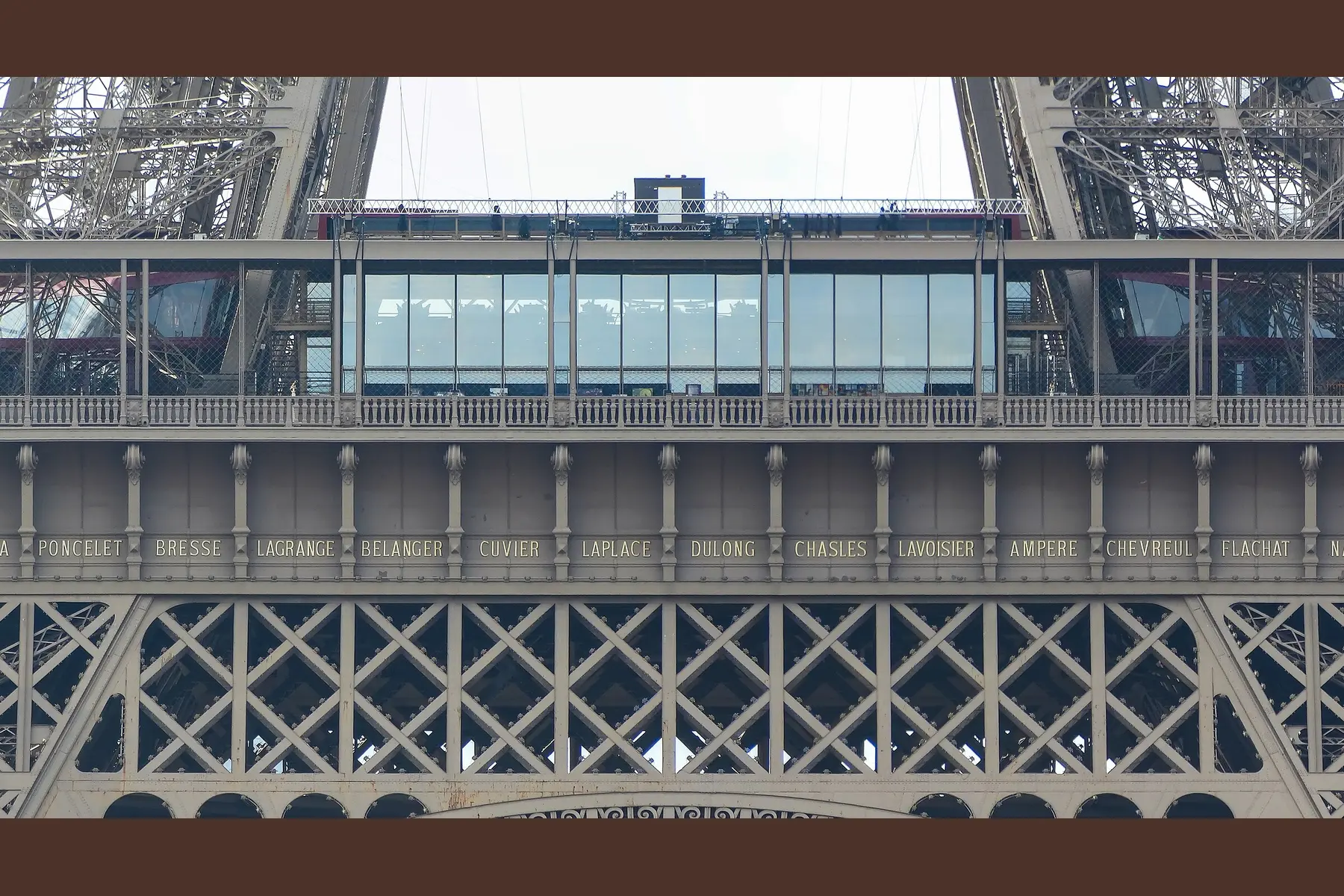
A frieze circles the Eiffel Tower’s first floor, easily missed by visitors focused on the summit. Gustave Eiffel had 72 names written there in gilded capital letters approximately sixty centimeters high. Each of the four sides carries eighteen. This was not a decorative afterthought added after the monument became successful. It belonged to the Tower’s symbolic program. Looking upward, visitors encounter more than the surname of one entrepreneur. They meet a community of scientists, engineers and industrial figures with whom Eiffel wanted the structure associated. The iron landmark becomes a monument to accumulated knowledge, although its selection remains profoundly shaped by nineteenth-century institutions.
Placing the Tower under the protection of science
The Tower was built for the 1889 Universal Exposition, held during the centenary of the French Revolution. Historian Bertrand Lemoine explains on the official Eiffel Tower site that the names placed the monument under the auspices of science and progress. The gesture also answered critics who saw the Tower as an industrial feat without culture. Its frieze argued that metal construction belonged to an intellectual inheritance. Was Gustave Eiffel also a scientist? extends that reading. The Tower would become more than an object to admire; it served as a platform for experiments.
Who qualified for this pantheon?
The 72 selected figures were French and had worked between 1789 and 1889. Almost all were dead by the inauguration, with physicist Hippolyte Fizeau the exception. The group brings mathematicians, physicists, chemists and astronomers together with engineers, contractors, industrialists and infrastructure planners. About thirty-four attended the École Polytechnique. “Scientists” therefore requires a broad nineteenth-century reading that includes theory, applied technique, enterprise and public works. This diversity is a useful key to who really designed the Eiffel Tower. A monument emerges from an ecosystem of calculation, materials, workshops and institutions.
Even the names faced an engineering constraint
The spaces between the supporting brackets imposed an unexpectedly physical rule: surnames could contain no more than twelve letters, with first names omitted. The limit helped exclude candidates such as Étienne Geoffroy Saint-Hilaire. The eighteen names on each face do not form a declared hierarchy; their order is described as random. This small fact exposes the meeting of homage and architecture. Even an intellectual pantheon had to fit a metal grid, respect a visual rhythm and remain legible from the ground. Guests can therefore read the frieze both as historical list and graphic composition.
A memory painted over and restored
The inscriptions disappeared beneath paint early in the twentieth century. They were restored in 1986 and 1987, a reminder that monuments do not reach the present without intervention. The Tower visible today is not an untouched surface from 1889; it is maintained, repainted and interpreted. The photograph used here shows part of the restored frieze on the northern facade. Its crop does not pretend to contain all 72 names. Instead, it makes the relationship among gilded letters, iron beams and the Paris landscape visible—the physical way an intellectual tribute was inserted into the structure.
The absence of women is historical evidence
No woman appears on the 1889 list. That absence cannot be explained by a lack of women working in science; it reveals the period’s institutions and mechanisms of recognition. In 2025, the City of Paris, the Eiffel Tower operating company and Femmes & Sciences initiated a project for a second frieze. Seventy-two proposed women’s names were unveiled on January 26, 2026 and sent to the relevant academies for validation. At the date this article was checked, official sources still described the addition as a future frieze. Advisors should not imply that the new names are already installed on the Tower.
From emblem to working laboratory
The names would be superficial if the Tower had not also supported research. Eiffel defended its preservation by offering its height for experiments and later developed sustained work in aerodynamics. The Auteuil wind tunnel follows his path from wind resistance toward systematic testing. The frieze and laboratory are not the same thing: one celebrates an inheritance while the other produces measurements. Their relationship still clarifies Eiffel’s strategy. For the Tower to endure, spectacle was not enough. He needed to demonstrate that it could help investigators understand the world.
B2B guidance: teach guests to read before ascending
For international advisors, the frieze creates an observation exercise available from the Tower’s surroundings without promising a ticket, first-floor access or particular opening time. Ask guests to identify one surname and connect the discipline to a physical aspect of the monument: calculation, iron, foundations, light or communication. The Elyrea Eiffel by Eiffel Encounter can turn the list into a conversation about progress and public memory, subject to separately confirmed availability. Guests then understand that the monument bears more than Eiffel’s name. It displays the collective image of science that his age chose to make visible.
FOR YOUR GUEST ITINERARIES
With Elyrea, read the Eiffel Tower as a statement about science, engineering and public memory as well as a Paris silhouette.
Discuss your itinerary