
The answer begins with the attribution
The familiar English phrase is a rendering of a story about brioche, a richer alternative to ordinary bread. Its usual association with Marie-Antoinette should not be treated as an established quotation. There is no solid evidence that she said it. That answer matters, but it is only the beginning of the subject. The more revealing question is how a line with an uncertain speaker became attached so firmly to one woman that many travelers hear it as a summary of her entire life.
What Rousseau's anecdote actually contributes
In Confessions, Jean-Jacques Rousseau recounts an anecdote about a great princess who responds to the absence of bread by suggesting brioche. He does not identify Marie-Antoinette as the speaker. The story belongs to a context preceding her life as queen of France. It therefore cannot be used as evidence that she made the remark. Distinguishing the anecdote from the later attribution is essential: a text can document the existence of a story without documenting the identity popular memory eventually assigns to its character.
Why the line sounded plausible to later audiences
A false attribution can gain strength when it agrees with an image people already accept. Marie-Antoinette came to represent spending, privilege and distance from the population's difficulties. A remark that appears oblivious to hunger fits that picture with striking economy. It compresses a large political accusation into a few words. The line's plausibility in popular imagination is therefore not proof of authenticity; it is evidence of the reputation against which people interpreted her. The myth tells us something about judgment, even when it cannot establish a historical utterance.
Bread gave the story political force
Bread mattered profoundly to everyday life in eighteenth-century France. Problems of supply and price affected the population directly, making an apparently dismissive royal response especially potent. Brioche in this story is not primarily a culinary detail. It symbolizes a privileged world supposedly unable to comprehend need. Understanding that contrast explains why the anecdote works so well as political shorthand. It does not require accepting the attribution. A traveler can recognize the significance of food within the period while separating it from a claim about what the queen said.
The hostile public image around the queen
Marie-Antoinette's Austrian origins, tastes and perceived influence offered material for pamphlets and rumor. Attacks frequently mixed political criticism with misogyny, xenophobia and allegations that should not be mistaken for documented fact. This does not make every criticism of monarchy invalid. It makes the distinction between political problems and personal caricature necessary. Why Marie-Antoinette became so disliked develops that wider setting, allowing the quotation to be examined as one part of a public image rather than a self-contained amusing correction.
The necklace affair shows how reputation filters events
Marie-Antoinette had not commissioned the necklace involved in the celebrated fraud, yet the affair further weakened her standing. Many observers were already prepared to believe in her extravagance. A scandal could therefore confirm the image even when her involvement was not what people imagined. The parallel with the brioche phrase is revealing: the reputation supplied an explanation that seemed stronger than inconvenient distinctions. These are not identical events, but together they show why correcting one factual detail may not be enough to overturn a deeply established public story.
Correcting the quotation is not a complete acquittal
Rejecting the phrase does not answer every question about Marie-Antoinette's political choices, the monarchy or its privileges. Nor should it lead to an opposite caricature of a woman who bore no responsibility for anything. Historical understanding requires examining separate claims separately. The queen behind the legend offers a broader view of her life and agency. The correction is valuable because it replaces an unreliable shortcut with a question, not because it produces a final moral verdict on the person.
A useful opening for a cultural conversation
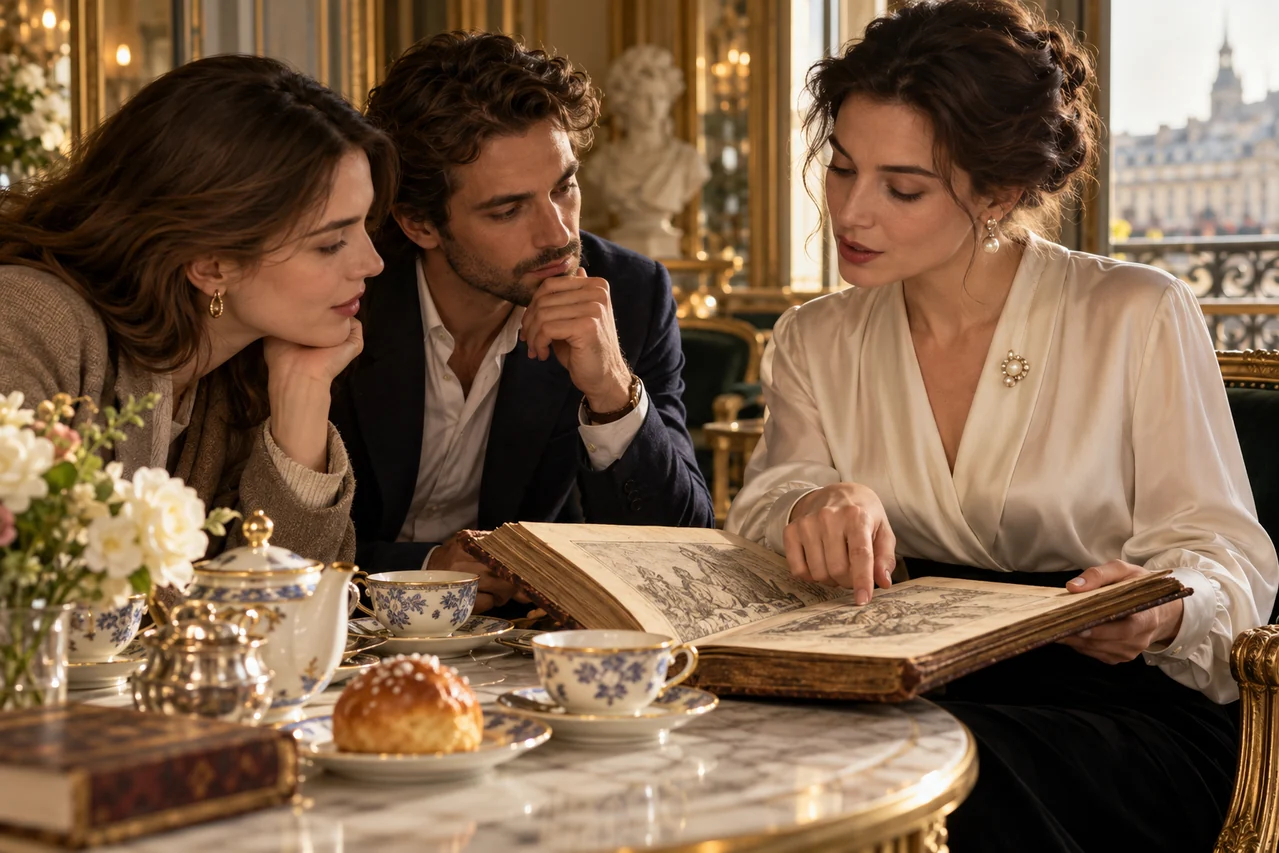
The phrase makes a strong starting point for guests who think they already know Marie-Antoinette. It turns their own assumptions into part of the historical subject. At Tea with Marie-Antoinette in Paris, an embodied interpretation can open conversation about reputation and the gap between a person and her public image. Families with teenagers and returning Versailles visitors may find this especially engaging. The lasting discovery is not merely that a quotation is doubtful, but how readily a compelling story can come to stand in for evidence.
FOR YOUR GUEST ITINERARIES
Preparing a cultural itinerary for guests curious about royal myths and reputation? Our team can help introduce these questions through Tea with Marie-Antoinette in Paris.
Discuss your itinerary