
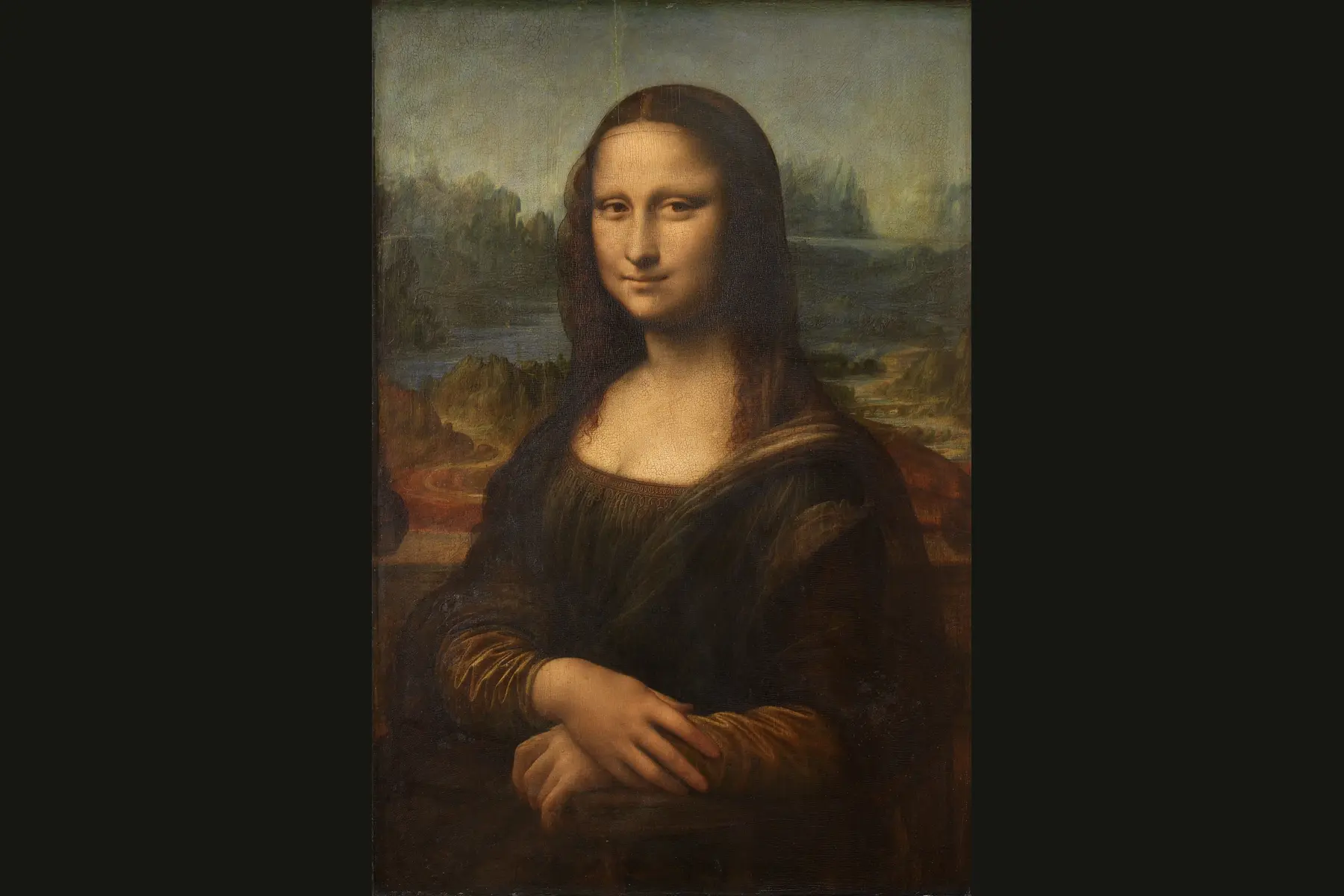
A simple question distorted by a familiar myth
Why does a portrait begun in Italy hang at the Louvre? A quick answer often claims that France stole it during a military campaign or that Napoleon carried it home from Italy. The Louvre’s official chronology tells a different story. Leonardo brought the painting with him when he moved to France at Francis I’s invitation. The museum states that the king bought it from him in 1518, bringing it into the royal collection. The Mona Lisa was therefore not a trophy seized centuries later. Its French history began with the voluntary journey of its maker and with the patronage relationship that shaped the final years of his life. That distinction replaces a dramatic misconception with a richer European history.
Leonardo traveled with a living work
The portrait is generally identified with Lisa Gherardini, wife of the Florentine merchant Francesco del Giocondo, and its creation began early in the sixteenth century. Leonardo did not hand it over as an ordinary commission permanently closed. He kept, revised and carried it through later movements. When he crossed the Alps for France in 1516, the panel remained part of his active intellectual world. Sfumato, changing light and the remote landscape did more than create an enigmatic smile. They embodied his understanding of painting as a science of life. Leonardo’s final years in Amboise places this famous panel among the drawings, designs and questions he continued to pursue in France.
Francis I as buyer and collector
The Louvre describes Francis I as one of the Mona Lisa’s earliest admirers. The king invited Leonardo to France and bought the painting from him in 1518. That transaction moved a work retained by the artist into the Crown’s holdings. It belonged to a wider policy of attracting creators, collecting Italian art and giving French kingship an international visual language. Purchase did not erase the portrait’s Florentine origin; it inscribed the work in Europe’s network of courts. Avoiding the language of theft does not mean claiming the picture was somehow always French. It means recognizing that artistic mobility, payment and patronage shaped collections long before the modern public museum and its national categories came into being.
From royal palaces to the Louvre Museum
After entering the royal collection, the Mona Lisa belonged to a mobile dynastic heritage shown in different palace settings before becoming part of the Louvre’s history. The French Revolution transformed the former royal palace into a public museum and opened Crown collections to a far broader audience. The Louvre notes that the painting has been displayed there since that revolutionary transition. Its current setting in the Salle des États belongs to a more recent museum history; since 2005 it has stood in a climate-controlled case protecting its vulnerable poplar panel. The answer to “why France?” therefore has two separate stages: a royal acquisition in the sixteenth century, followed much later by the conversion of dynastic property into a national institution.
Napoleon did not bring the Mona Lisa from Italy
The misconception persists because Revolutionary and Napoleonic campaigns really did move many European works to Paris. The Mona Lisa, however, had already been in French royal holdings for nearly three centuries. Napoleon temporarily placed it in the Tuileries Palace, reportedly in his apartments, before it returned to the Louvre; he did not conquer it in Italy. Correcting the story helps distinguish several forms of movement: an artist traveling with a painting, a princely purchase, dynastic inheritance, military seizure and transfer into a museum. Treating them as one process produces a dramatic but inaccurate history. Separating them makes the object’s biography more revealing and prevents a single modern narrative from being projected onto every European collection.
The 1911 theft intensified its French connection
On August 21, 1911, Vincenzo Peruggia stole the Mona Lisa from the Louvre. He later presented his act partly as a return to Italy, invoking or benefiting from the mistaken idea that Napoleon had taken it. Recovered in Florence in 1913, the work came back to France after being displayed in Italy. The episode transformed its fame: newspapers, photographic portraits and public suspense made the absent painting globally present. It also exposed the power of simplified national stories. Leonardo’s and Lisa Gherardini’s Italian origins are beyond dispute; the Louvre’s account of Francis I’s acquisition is equally clear. The painting’s Franco-Italian trajectory cannot be reduced to one emotional ownership claim. It belongs to a European history of creation, movement and care.
Looking past the glass and the crowd
In the Salle des États, celebrity can overwhelm the painting itself. Knowing how it reached France restores a more intimate scale: a poplar panel kept for years by its maker, built through delicate layers, then shown to a king eager to bring Renaissance excellence to his court. Its modest dimensions contrast with its immense symbolic weight. The protective case, required for security and stable temperature and humidity, reminds viewers that this is a vulnerable material object rather than an abstract icon. The Mona Lisa was not born famous. By connecting technique, travel and collecting, visitors can recover the painting beneath the legend and understand why Francis I recognized its value long before a global museum audience made it unavoidable.
B2B guidance: build an itinerary around provenance
For travel advisors, provenance can offer a stronger narrative than a sequence of masterpieces. The Elyrea Leonardo da Vinci Encounter can begin in Amboise, where the artist lived under royal protection, and follow his paintings into French collections. The legend of his death in Francis I’s arms provides a useful counterpoint: the relationship was real, the final scene was invented. Romorantin then shows that patronage extended to urban ambition. This structure turns the popular question “why is the Mona Lisa in France?” into a rigorous exploration of mobility, taste and power.
FOR YOUR GUEST ITINERARIES
Elyrea connects the Mona Lisa to Leonardo’s final French years in a private Encounter designed to move beyond familiar myths.
Discuss your itinerary