
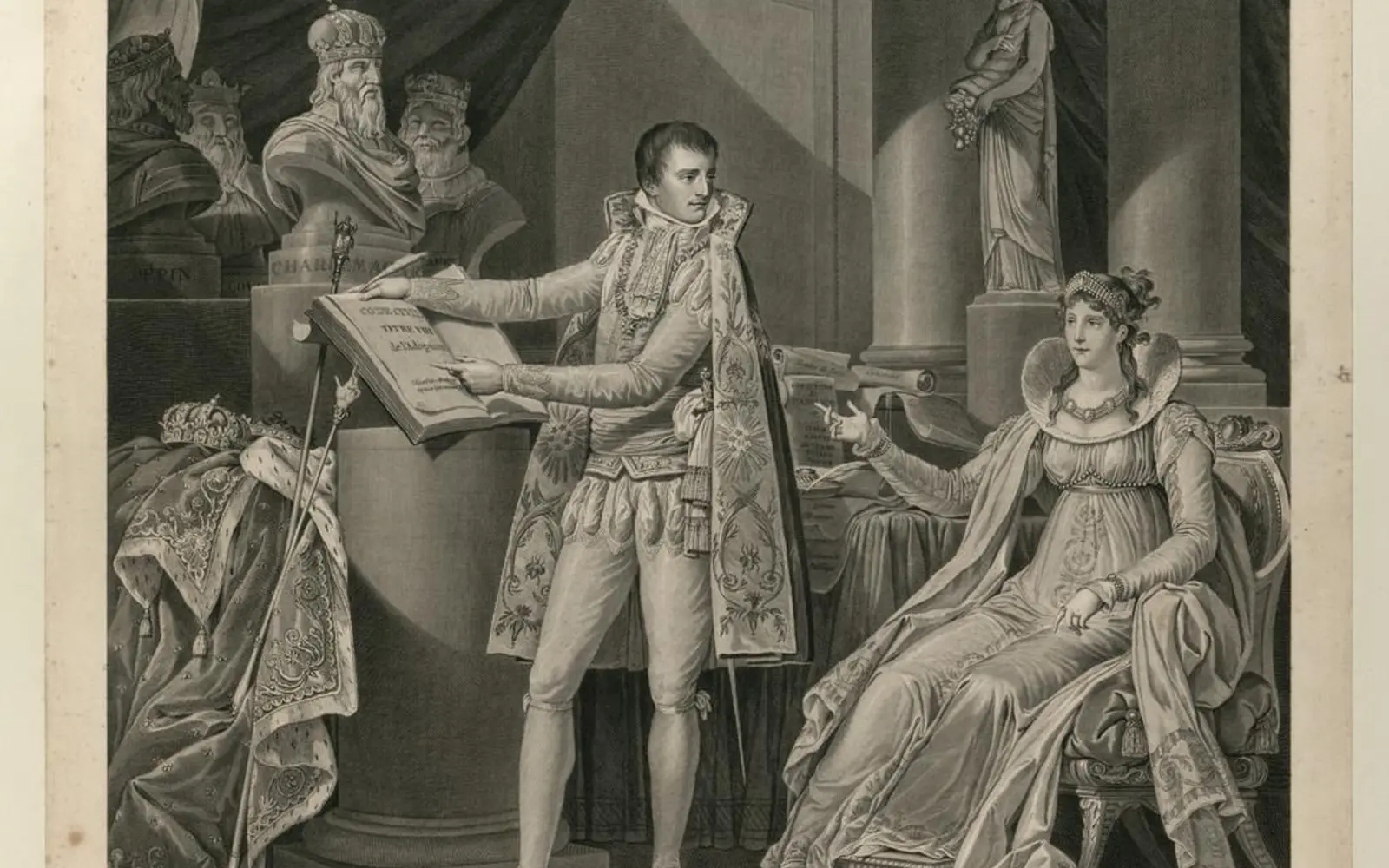
The short answer: he drove it, but did not write it alone
The Civil Code was neither Napoleon’s personal manuscript nor a finished administrative compilation awaiting his signature. As First Consul, Bonaparte revived a unification project that revolutionary governments had repeatedly failed to complete, followed the debates and supplied the political pressure required for adoption. The technical draft came principally from four jurists: Portalis, Tronchet, Bigot de Préameneu and Maleville. The most accurate account is therefore a collective legal work shaped by decisive political sponsorship.
Why France wanted one body of civil law
Before 1789, regional customs, Roman-law traditions in the south, royal ordinances and court practice formed a fragmented legal landscape. The Revolution proclaimed civil equality and abolished privileges, but successive code projects stalled. Common rules for persons, property, contracts and family life answered both an ideological and a practical need: citizens should be able to identify the civil law applying to them throughout France rather than navigate inherited territorial systems.
Four jurists brought different traditions together
The commission appointed in 1800 combined lawyers able to reconcile customary and written law. Portalis supplied much of the project’s intellectual framework; Tronchet brought deep knowledge of Parisian custom; Bigot de Préameneu and Maleville helped test provisions article by article. The draft was not a legal blank slate. It sought a settlement between pre-revolutionary learning, revolutionary principles and the new regime’s demand for stability. That synthesis produced both durability and compromise.
Napoleon took part in Council of State debates
Bonaparte attended many Council of State sessions and engaged with practical questions. Participation did not make him the code’s lawyer-author, yet his presence affected pace, arbitration and the determination to finish. After an early legislative setback, the procedure changed: provisions were passed as thirty-six separate laws from 1803 to 1804 and then consolidated. The Code civil des Français was promulgated on March 21, 1804, with 2,281 articles.
One law did not mean complete equality
The Code protected important achievements, including male civil equality, property, freedom of contract and a secular system of civil status. Its structure and relatively clear language offered legal stability. Yet promised universality must not be mistaken for modern equality. Family law reinforced the authority of husbands and fathers, while married women faced severe restrictions on legal capacity. The settlement of 1804 joined some revolutionary gains to a strongly hierarchical domestic order.
How a collective code became the Code Napoleon
The text officially became the Code Napoléon in 1807 as imperial government folded law into dynastic prestige. The title exposes the politics of memory: a collective institutional achievement became attached to one exceptional individual. Like the imperial bee, the name connected administration, symbolism and authority. Regimes later changed the official title, but the international association with Napoleon proved remarkably durable.
A living legacy, not an untouched document
The Code influenced legal systems across Europe and beyond, whether directly or through local adaptation. It remains a foundation of French civil law, but its substance has been repeatedly reformed. Family relations, equality between spouses, parentage, property and obligations are not governed as they were in 1804. Continuity therefore does not mean 2,281 frozen articles. Part of the legacy is the idea of an organized, public body of private law that can itself be revised.
B2B guidance: frame a political decision, not a monument
For international advisors, the Civil Code reveals a Napoleon beyond the battlefield. Ask how a leader converts revolutionary change into institutions, then identify who remained excluded from the promise of common law. The Elyrea Napoleon Encounter can open that discussion about power, reform and historical memory, subject to separately confirmed availability. Guests receive a question to debate rather than an uncomplicated celebration.
FOR YOUR GUEST ITINERARIES
With Elyrea, place the Civil Code inside the ambitions, decisions and contradictions of Napoleonic power.
Discuss your itinerary