
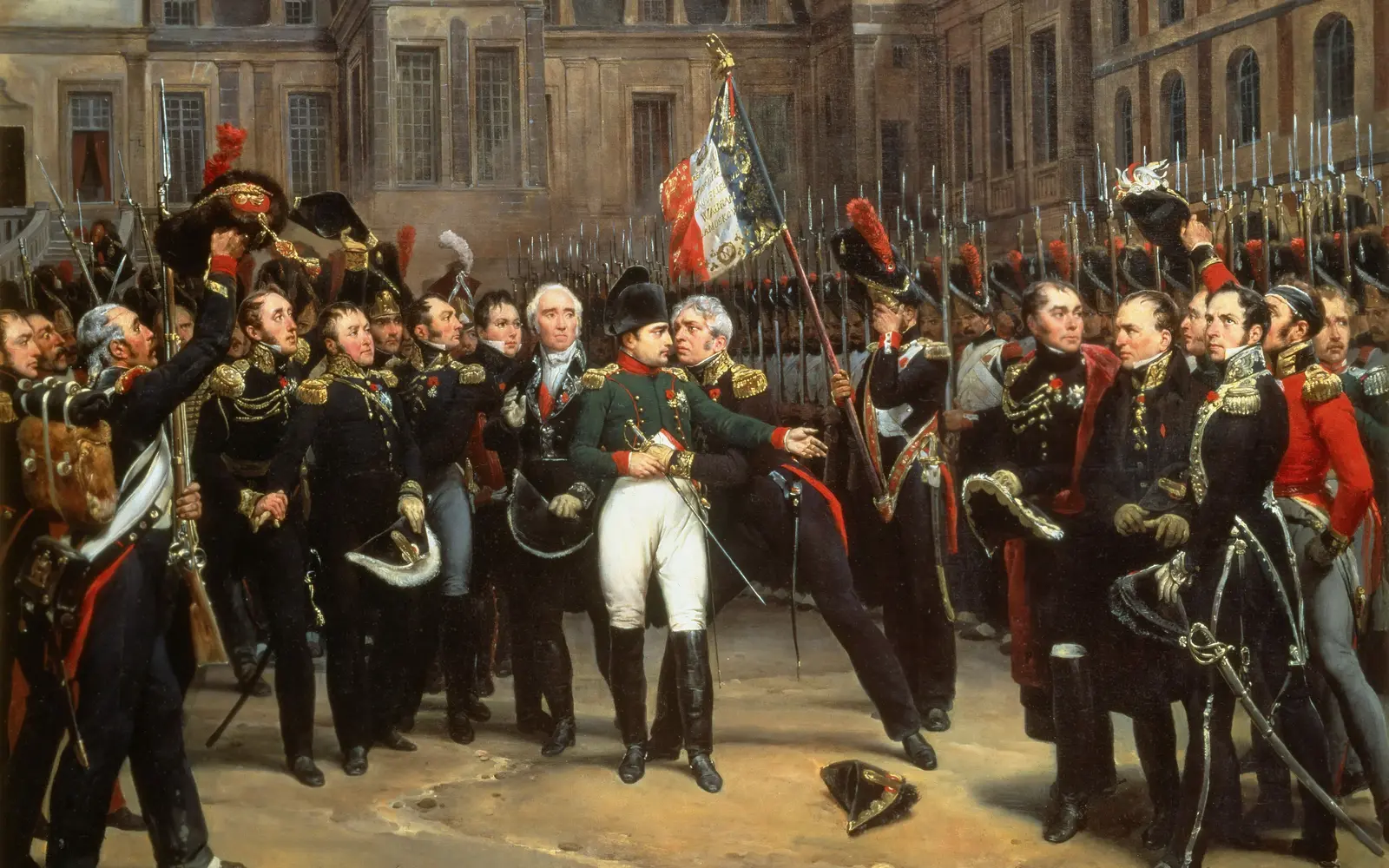
A courtyard renamed by an event
Fontainebleau’s Cour d’Honneur is also known as the Cour des Adieux, or Court of Farewells. The name comes neither from its original plan nor from a medieval custom. It records a dated event: on April 20, 1814, Napoleon left the soldiers of his Guard there before departing for Elba. The Château’s official history places the scene at the foot of the Horseshoe Staircase. The architecture already existed, but a political gesture permanently changed the way later visitors would read it.
From the campaign for France to abdication
In spring 1814, Allied armies entered Paris and the Senate declared Napoleon deposed on April 2. At Fontainebleau, he initially sought a dynastic solution before relinquishing the throne. Acts of abdication and the settlement negotiated with the victorious powers organized his departure. He was granted sovereignty over Elba, yet he was leaving a defeated France. Sequence matters: the farewell did not cause the abdication. It gave a public and emotional form to a political break that had already taken place.
April 20 at the foot of the staircase
The Guard assembled in the courtyard. Napoleon descended the staircase, addressed his companions and took leave of them. Accounts describe his embrace of General Petit and his kiss on the flag, a gesture that condensed the impossibility of embracing every soldier. Several versions of the speech survive. The Fondation Napoléon compares the text later published by Baron Fain with a shorter original formulation. A responsible interpretation can explain the speech’s meaning without treating a later literary transcript as if it were a recording.
A speech of loyalty and renunciation
Napoleon praised the courage and fidelity of the Old Guard while arguing that continued conflict would become interminable and risk civil war. The speech recast defeat as a sacrifice accepted for France. It is a compelling act of narrative control: a commander separated from his army reaffirmed bonds forged through campaigns and gave his departure a national justification. How Napoleon built his legend helps travelers distinguish the scene’s rhetorical power from the complicated military and diplomatic decisions of 1814.
Why Fontainebleau makes such a powerful stage
The monumental staircase creates a visible transition between palace and courtyard. Napoleon’s descent turns the passage from sovereign in his apartments to departing leader into physical movement. The Château notes that he signed his abdication in the adjacent salon before the farewell. Architecture and history therefore reinforce one another even though the setting was not designed for this event. Fontainebleau from kings to Barbizon painters reveals how palace, forest and village carry very different memories beneath one place name.
Horace Vernet painted memory, not reportage
Horace Vernet produced the painting used here in 1825, eleven years after the farewell. His composition arranges soldiers, flag and emperor so that the emotional center is immediately legible. It should be read as a historical interpretation rather than a photographic record of the courtyard in 1814. The public-domain status allows reproduction and cropping. The work is valuable precisely because it shows how the nineteenth century imagined, organized and circulated the memory of Napoleon’s departure.
A farewell that was not the final appearance
Napoleon left for Elba after Fontainebleau, but the story did not end in the courtyard. In March 1815 he returned to France and stopped again at the palace during the Hundred Days. That continuation prevents modern viewers from treating April 20 as the definitive ending already known to everyone present. For the participants, the farewell opened uncertainty. For today’s visitor, the scene gains power from the contrast between their unfinished moment and our retrospective chronology leading to Waterloo and Saint Helena.
B2B guidance: connect gesture with setting
A cultural itinerary can use the courtyard as an exercise in reading place without promising access to apartments, a reenactment or a particular opening time. Ask guests to observe the relationship among staircase, threshold and assembled group, then compare it with Vernet’s composition. The Elyrea Fontainebleau Encounter explores other narrative layers of the territory and must be presented according to its confirmed format and availability. The purpose is to understand how a place acquires a name and becomes the durable carrier of collective memory.
FOR YOUR GUEST ITINERARIES
With Elyrea, discover how one Fontainebleau setting preserves the memory of a political collapse transformed into a historic scene.
Discuss your itinerary