
Begin with Bartholdi
The Statue of Liberty was the monumental sculptural project of Frédéric Auguste Bartholdi. Its figure, meaning and external conception should not be attributed to Eiffel. That distinction matters because travelers often encounter the connection as an intriguing fact detached from its context. A useful account preserves the artist's role while explaining why a sculpture on this scale also needed engineering expertise. Several kinds of creation were involved, and recognizing them strengthens rather than diminishes the achievement.
A monumental figure creates structural problems
An enormous metal statue must respond to weight, wind and changes in temperature. Its outer skin cannot simply be imagined as a small sculpture enlarged without consequence. Support must allow the figure to function under real physical conditions. This is where the engineering story begins. Visitors accustomed to viewing Liberty as an image can think instead about what remains hidden: how a recognizable exterior is sustained, and how its parts interact when the environment places demands on them.
From Viollet-le-Duc to Eiffel's team
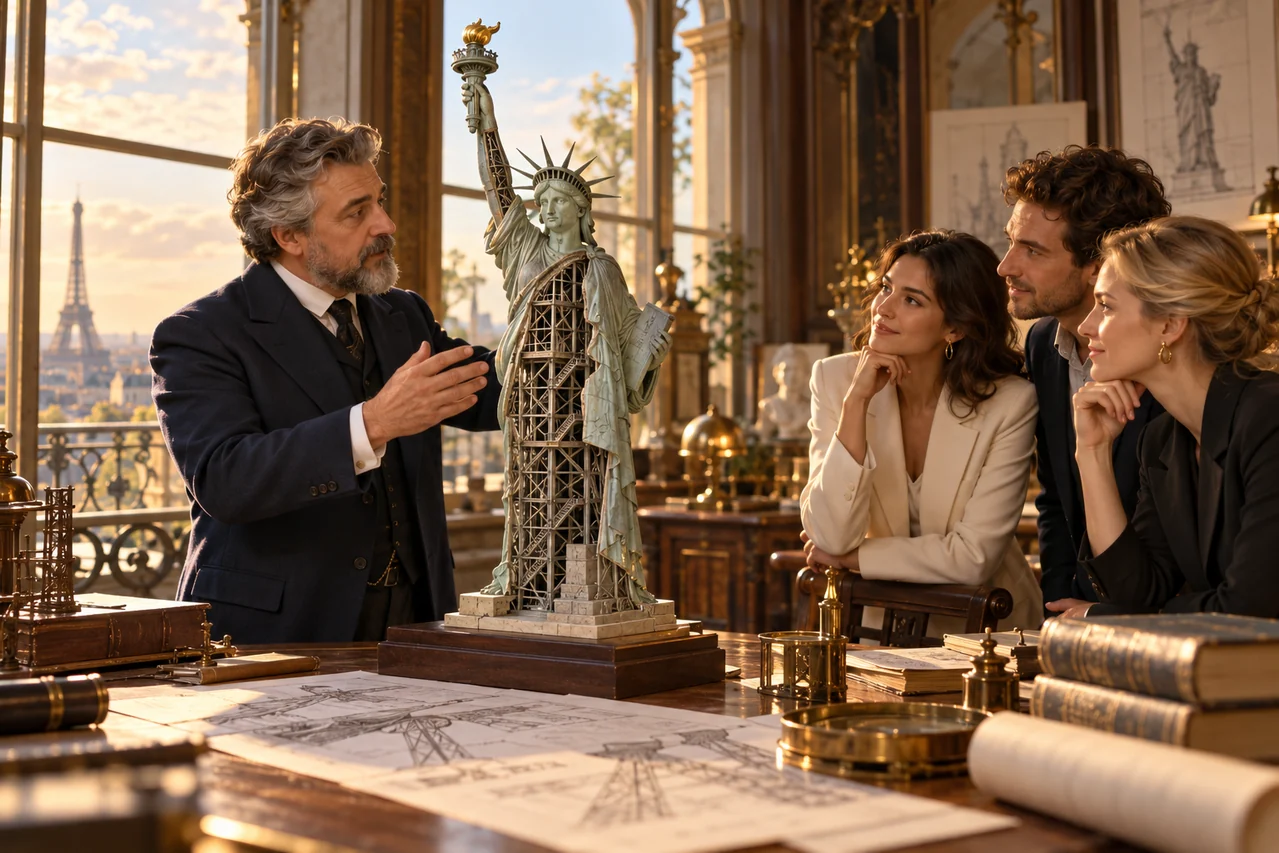
Eugène Viollet-le-Duc worked on the statue's initial structural solution. After his death in 1879, Eiffel and his team became involved in developing its support system. The sequence is important. It avoids a story in which one engineer appears to have solved a problem with no predecessors and no collaborators. Each contribution belongs to a different stage of the project. The structure ultimately associated with Eiffel should be understood through that transition rather than as evidence of sole authorship of the entire monument.
Supporting the copper envelope
The internal metal framework allowed the copper exterior and supporting structure to work together. Managing physical constraints involved more than making the statue rigid. The engineering had to accommodate the realities of a large envelope exposed to its surroundings. For travelers, the key idea is accessible without a technical diagram: the sculptural form and its support perform different tasks. A monument's visible appearance may be the work of one specialist, while another makes that appearance structurally possible at its intended scale.
The company supplied collective expertise
As with the Paris tower, Eiffel's contribution came through an organization containing skilled people and established knowledge of metal construction. A famous personal name can obscure that collective work. The tower's designers provide a useful parallel, since Koechlin, Nouguier and Sauvestre deserve their own places in that story. Neither landmark benefits from a competition over which single individual should receive every credit. The more illuminating approach is to ask which tasks required which kinds of expertise.
A natural connection for American travelers
For visitors from the United States, the story creates a real relationship between two landmarks already embedded in their imagination. Paris and New York become linked through engineering as well as symbolism. An advisor can use the connection to anchor a conversation about international projects and the movement of knowledge. It is especially useful for families whose members may have seen Liberty, because a familiar reference supplies an immediate way into the less familiar career of a French engineer.
The tower was part of a larger career
Eiffel's work associated with Liberty preceded the construction of his Paris tower. This chronology helps travelers see the tower within an accumulated body of experience, rather than as an isolated achievement that appeared without preparation. The man behind the tower worked across projects involving different functions and settings. Comparing them reveals both continuity and difference: a statue's internal support and a freestanding exposed tower share engineering concerns, but neither should be treated as simply a version of the other.
Using the connection in an itinerary
A cultural program can introduce Liberty's structure while standing near the Eiffel Tower, then let guests observe the visible metalwork with greater curiosity. The connection should enrich an Encounter rather than displace the Paris setting with a long unrelated lecture. Elyrea's Eiffel by Eiffel allows character, place and conversation to meet in that recognizable landscape. It offers American travel advisors a focused thematic bridge, with accurate attribution and no need to invent special access or a historical relationship beyond the documented engineering contribution.
FOR YOUR GUEST ITINERARIES
Creating a Paris program for American guests? Ask Elyrea how Eiffel by Eiffel can connect the tower’s story with the engineering inside the Statue of Liberty.
Discuss your itinerary